
俞艾静在语音学顶级国际学术会议Speech Prosody发表论文并做海报展示
Ironic Prosody Perception in Mandarin: The Role of Autistic Traits
Abstract:
As a complex form of figurative language, irony is frequently used in Mandarin Chinese dialogue, yet its prosodic processing remains underexplored compared to non-tonal languages. While prosodic cues, such as pitch, intensity, and duration, are crucial for identifying speakers’ nonliteral meaning, their communicative efficacy may be modulated by individual differences. This study investigates the extent to which autistic traits influence the perception of Mandarin ironic prosody. 20 native Mandarin-speaking college students, assessed by the Autism-Spectrum Quotient (AQ), completed a context-free auditory discrimination task in which they listened to four sentence types (literal praise, literal criticism, ironic praise, and ironic criticism) and judged whether each utterance was literal or ironic based solely on prosody. The results indicated a significant asymmetry in irony perception. Participants achieved near-ceiling accuracy for literal utterances and relatively high accuracy for ironic criticism, but exhibited difficulties in recognizing ironic praise. Notably, AQ were negatively correlated with accuracy for ironic praise. These findings indicate that prosodic cues aid perception of ironic criticism but are constrained for ironic praise, and that individual autistic traits may modulate performance in the most demanding condition.
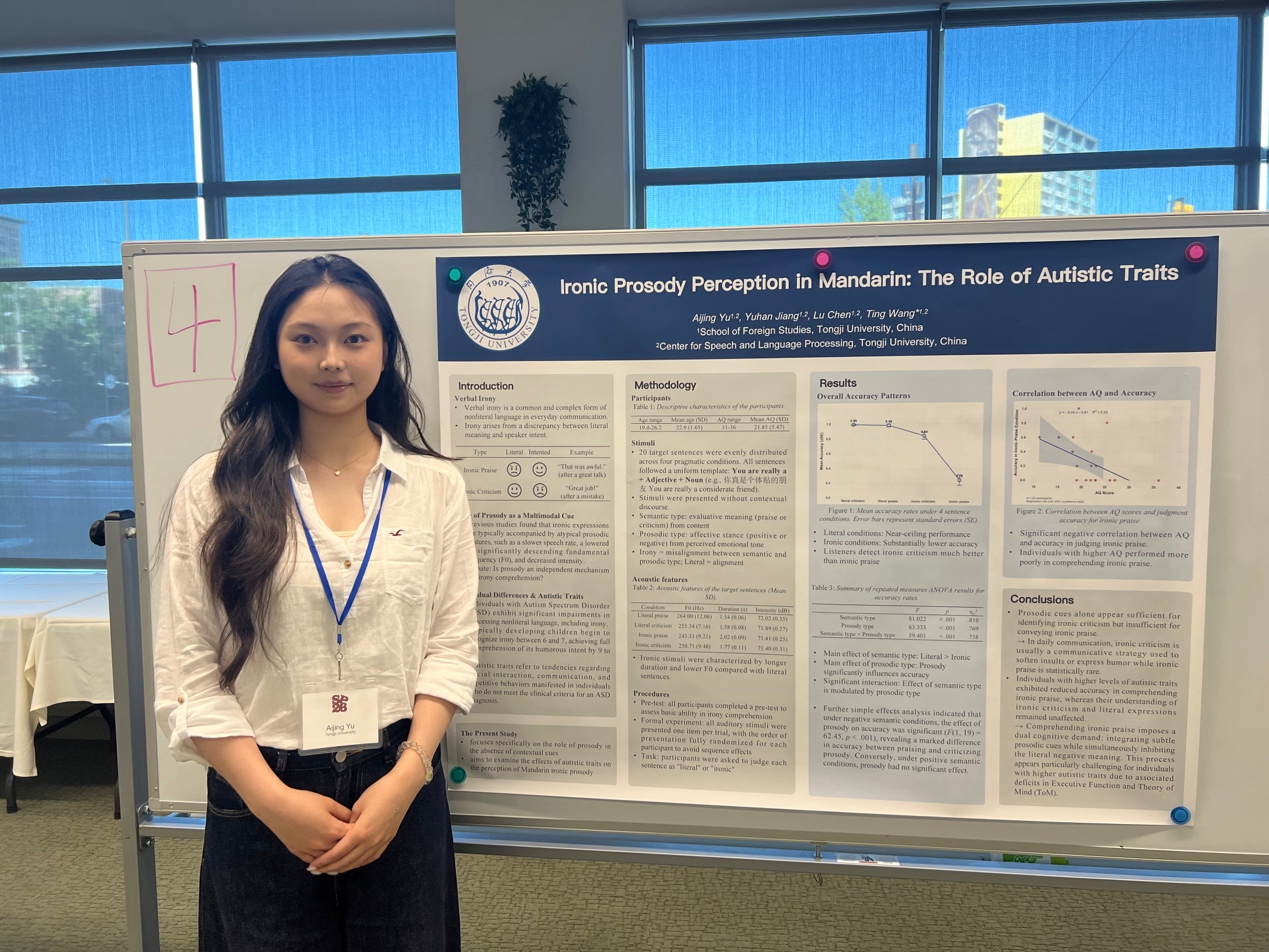
原载Yu, A., Jiang, Y., Chen, L., Wang*, T. (2026) Ironic Prosody Perception in Mandarin: The Role of Autistic Traits. In Proceedings of Speech Prosody 2026, 785-789.