
陈璐在语音学顶级国际学术会议Speech Prosody发表论文并做口头报告
Linguistic Complexity Modulates Pitch Variability in 3-5-Year-Old Mandarin-Speaking Children
Abstract:
Children’s prosodic performance depends not only on laryngeal physiological development but is also constrained by cognitive resource allocation and linguistic proficiency. While young children possess wide physiological pitch ranges, their pitch strategies under high linguistic load remain unclear. This study investigates the interplay between physiological constraints and cognitive strategies in early prosodic development. We analyzed 1,350 spontaneous declarative sentences from 45 Mandarin-speaking children (ages 3 to 5). Linear mixed-effects models were used to examine how utterance length, lexical diversity, and syntactic complexity affect pitch range and stability across ages. Results indicated that although higher linguistic complexity consistently predicted wider pitch ranges, 4 and 5-year-olds exhibited lower pitch ranges than 3-year-olds. Specifically, for utterance length, the tendency to expand pitch range diminished significantly with age. Regarding pitch standard deviation, complexity significantly increased instability only in 3-year-olds, whereas 4 and 5-year-olds maintained stability regardless of cognitive load. These findings suggest that while 3-year-olds employ exaggerated prosody to facilitate expression and cope with high cognitive load, 4 and 5-year-olds shift toward stable prosodic strategies, reflecting matured neuromotor control and linguistic competence.
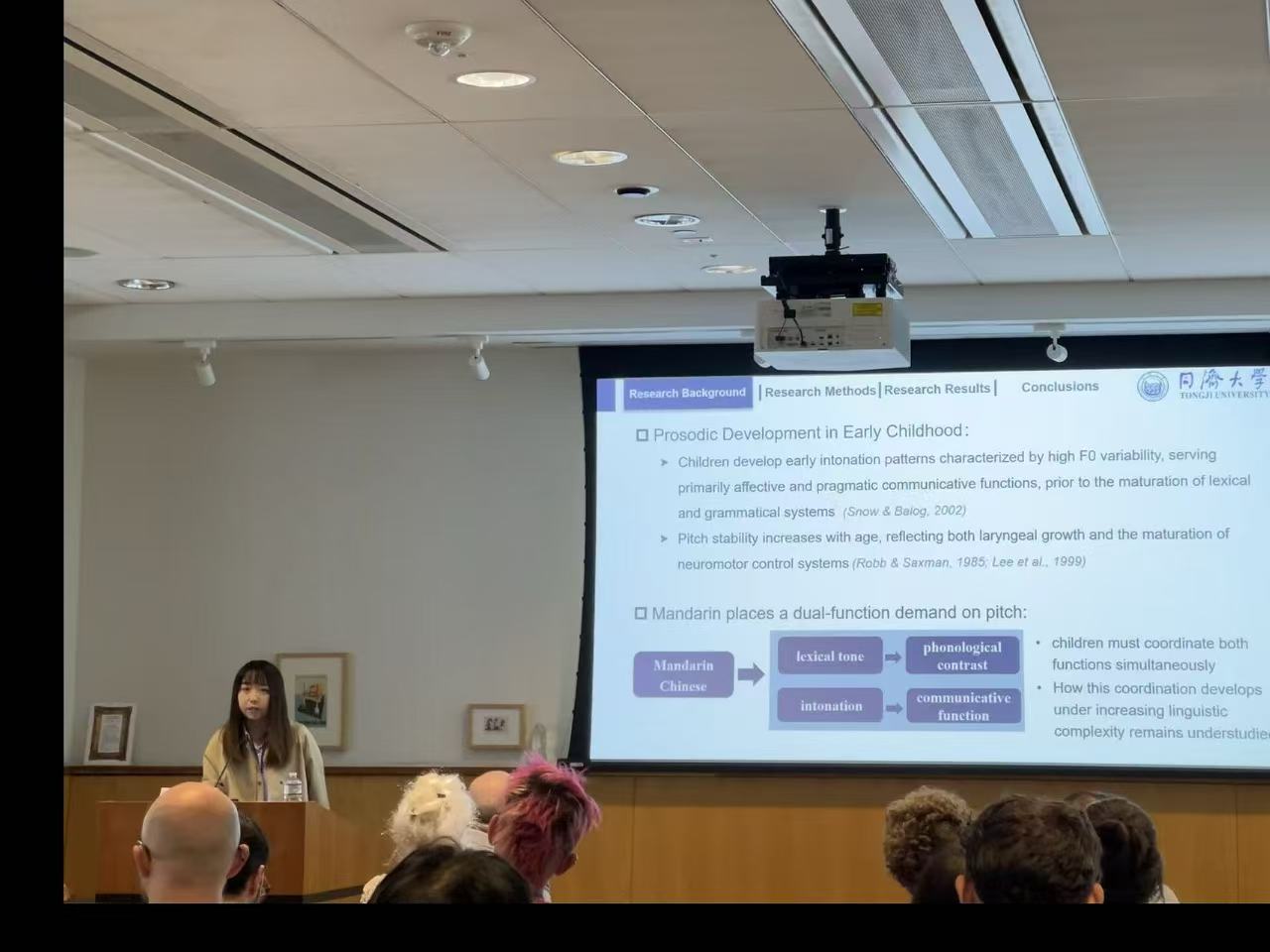
原载Chen, L., Yu, A., Jiang, Y., Wang*, T. (2026) Linguistic Complexity Modulates Pitch Variability in 3-5-Year-Old Mandarin-Speaking Children. In Proceedings of Speech Prosody 2026, 189-193.